Frequency containment
AvailableFCR-N, FCR-D up and down, and FFR run as local droop regulators on the edge with Nordic energy management (NEM/AEM) built in. Frequency is read on site every control tick; delivery does not depend on the cloud link.
 EVORA LABS
Product datasheet
Neutral control layer and operations platform for flexible energy assets
Evora EMS connects battery storage, PV and metering to energy markets through one controller the asset owner controls. Any optimizer or balancing service provider submits schedules through a single API; the Evora edge executes them inside operator-owned safety limits, keeps delivering through cloud outages, and reports back what was actually delivered.
The platform automates integration, prequalification testing and day-to-day operations so a site is market-ready in a fraction of the usual time, while the owner keeps full choice of trading partners.
2 s
local control loop, safety-clamped on every setpoint
72 h
offline telemetry buffer with zero-loss backfill
< 100 ms
dispatch delivery after link recovery
5
prequalification programs: FCR-N, FCR-D, FFR, aFRR, mFRR
30+
device register maps across seven asset classes
Energy management strategies
EVORA LABSEvery strategy runs on the edge inside the operator's safety envelope. Services stack where the asset allows it and are curtailed by priority when it does not; the same controller executes market services, tariff optimisation and third-party schedules.
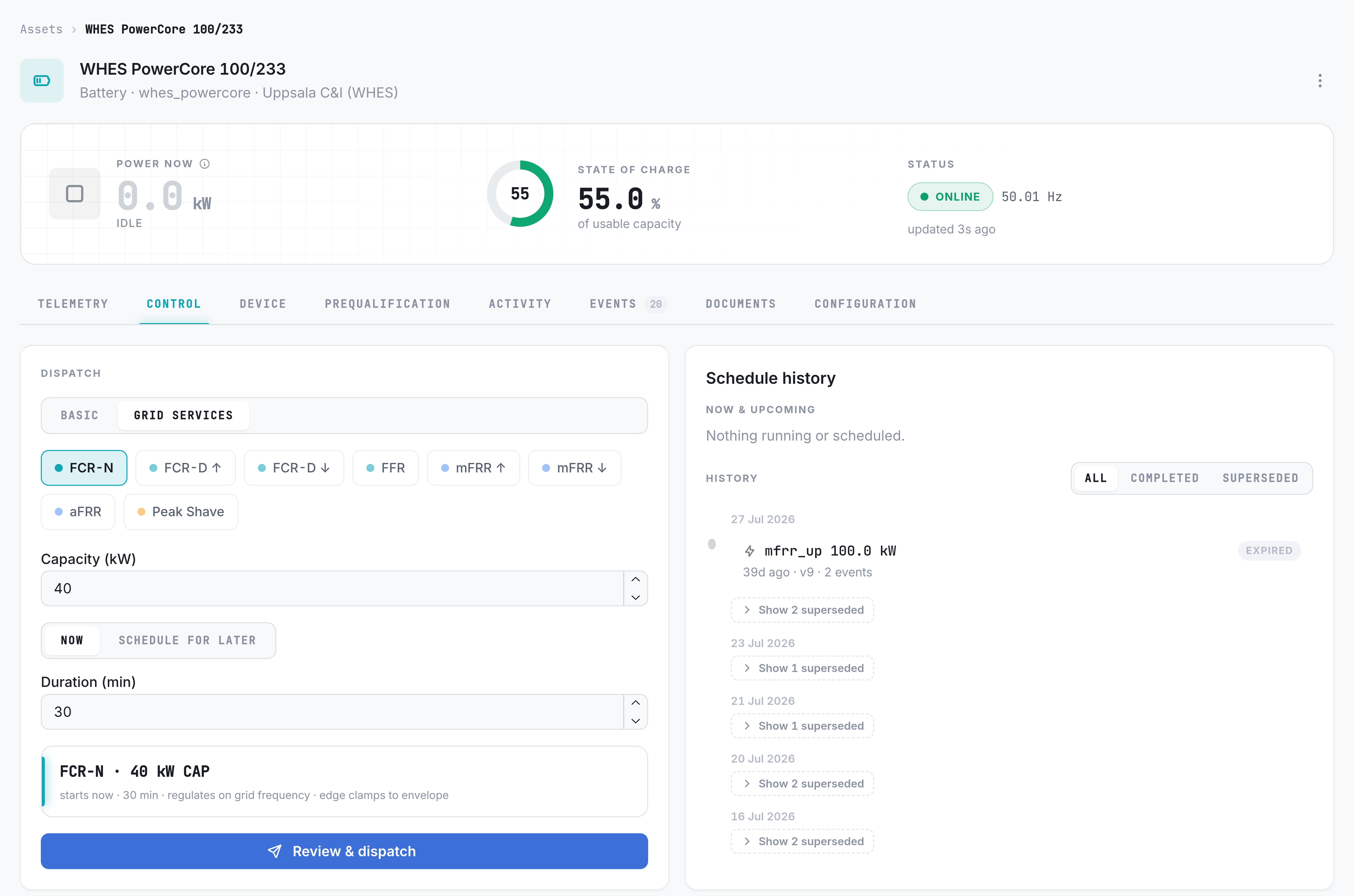
FCR-N, FCR-D up and down, and FFR run as local droop regulators on the edge with Nordic energy management (NEM/AEM) built in. Frequency is read on site every control tick; delivery does not depend on the cloud link.
Setpoint-following aFRR and order-driven mFRR activation with configurable preparation and ramp profiles. Sub-MW assets take part through aggregated groups across sites in one bidding zone.
Holds site import below a ceiling from the grid meter, discharging only what the load demands. Built for capacity-based tariffs such as the Swedish power tariff in force from 2027, and stackable with market services outside peak hours.
Day-ahead and intraday plans from any optimizer are submitted through one API under an exclusive lease with scope and power caps. The edge executes, the platform acknowledges, settles every interval and flags deviations.
Active-power ceiling on PV inverters from the same register library, for feed-in limits and grid-connection constraints. Rig-tested on a 110 kVA string inverter map.
Charging surplus generation and discharging into local load. Planned on top of the peak-shaving controller and the site meter path.
Evora platform
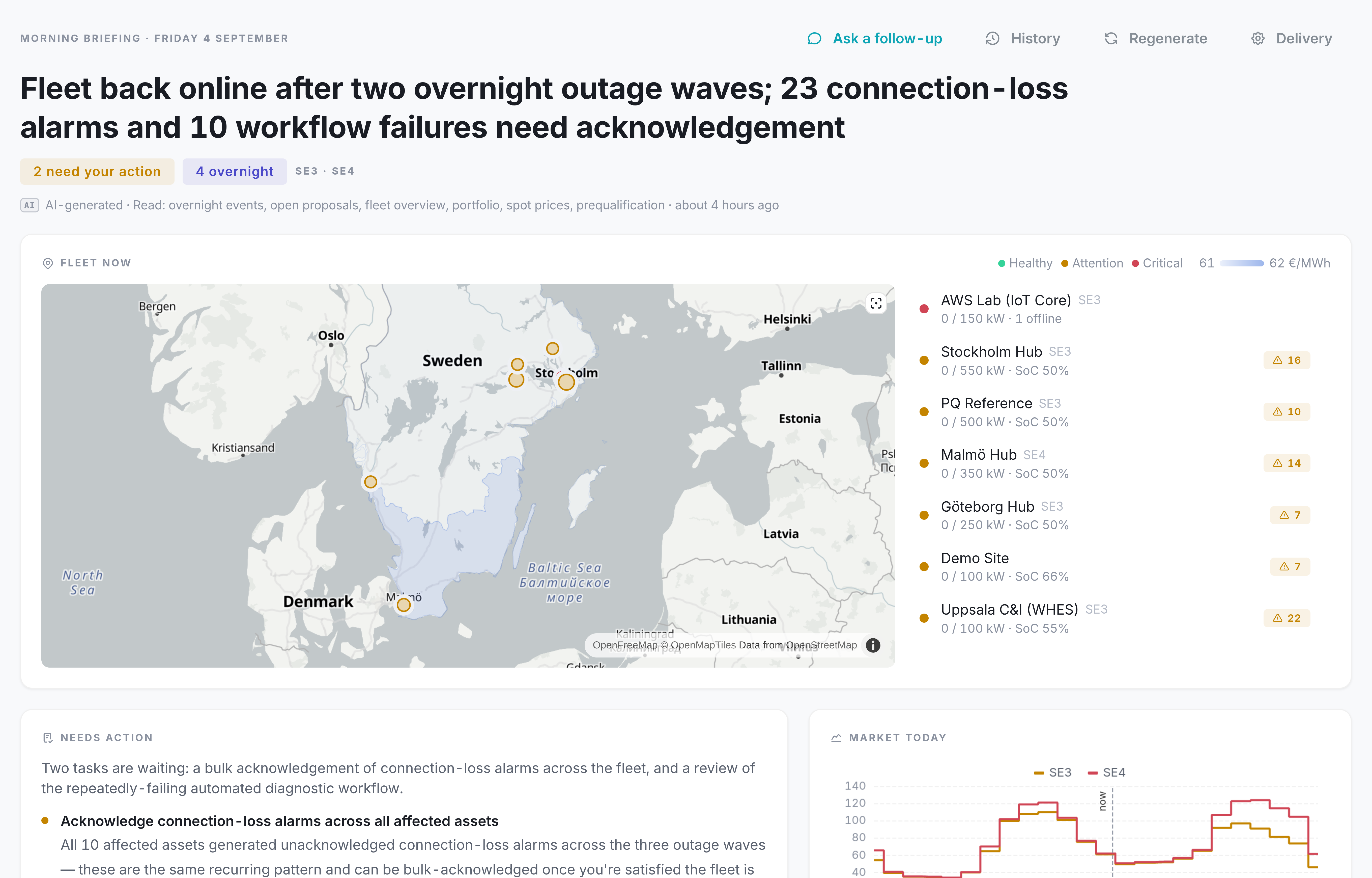
EVORA LABSThe Evora portal is the operator's view of every site: live telemetry and device registers, dispatch and schedule history, prequalification evidence, and the AI-assisted operations layer on top.
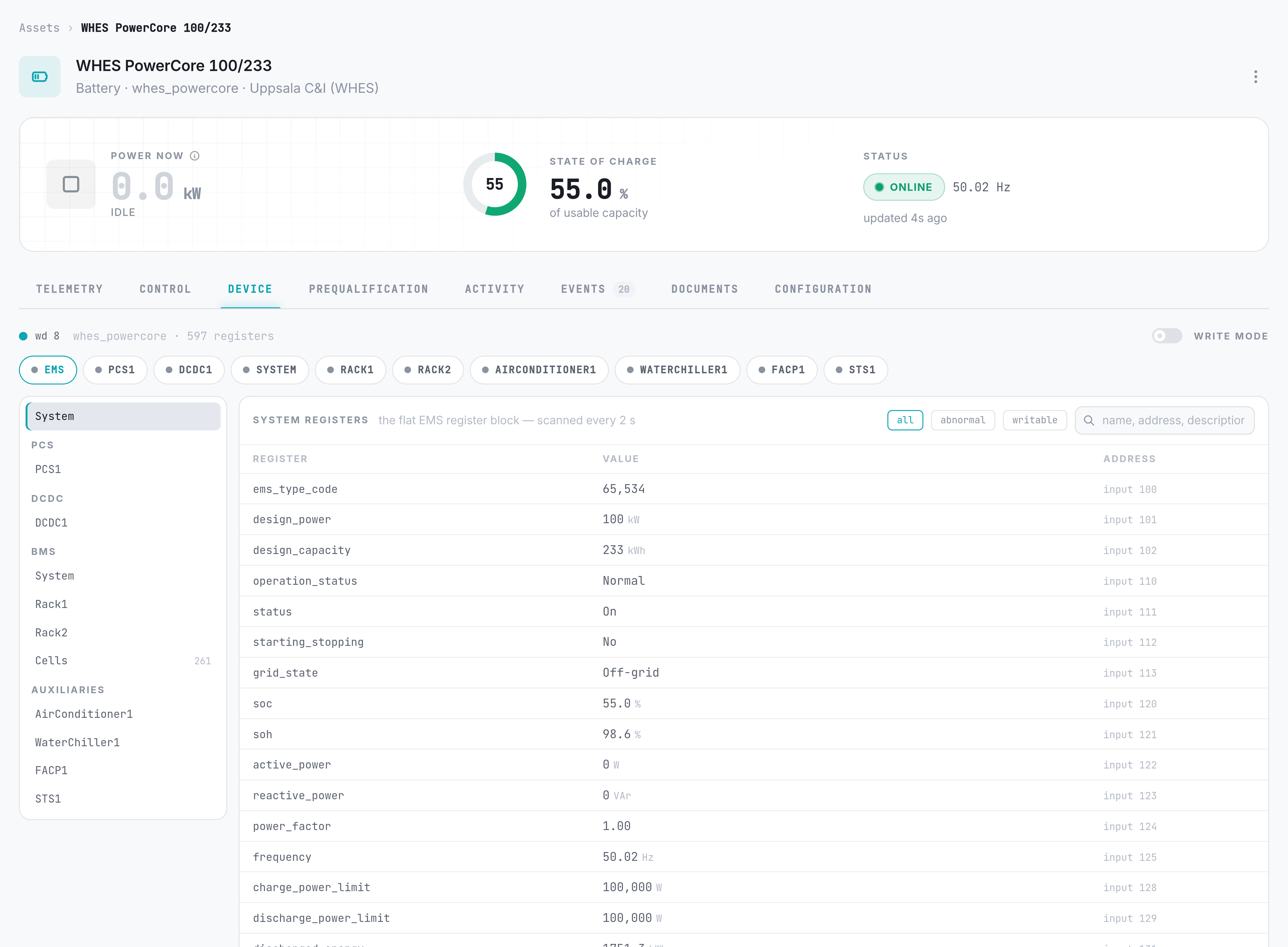
Fleet map with health and zone prices, per-asset telemetry, live device registers, cell-level battery health, alarms and event history.
Operator-owned safety envelope, stale-schedule fallback, emergency stop, device watchdog and a full command audit trail.
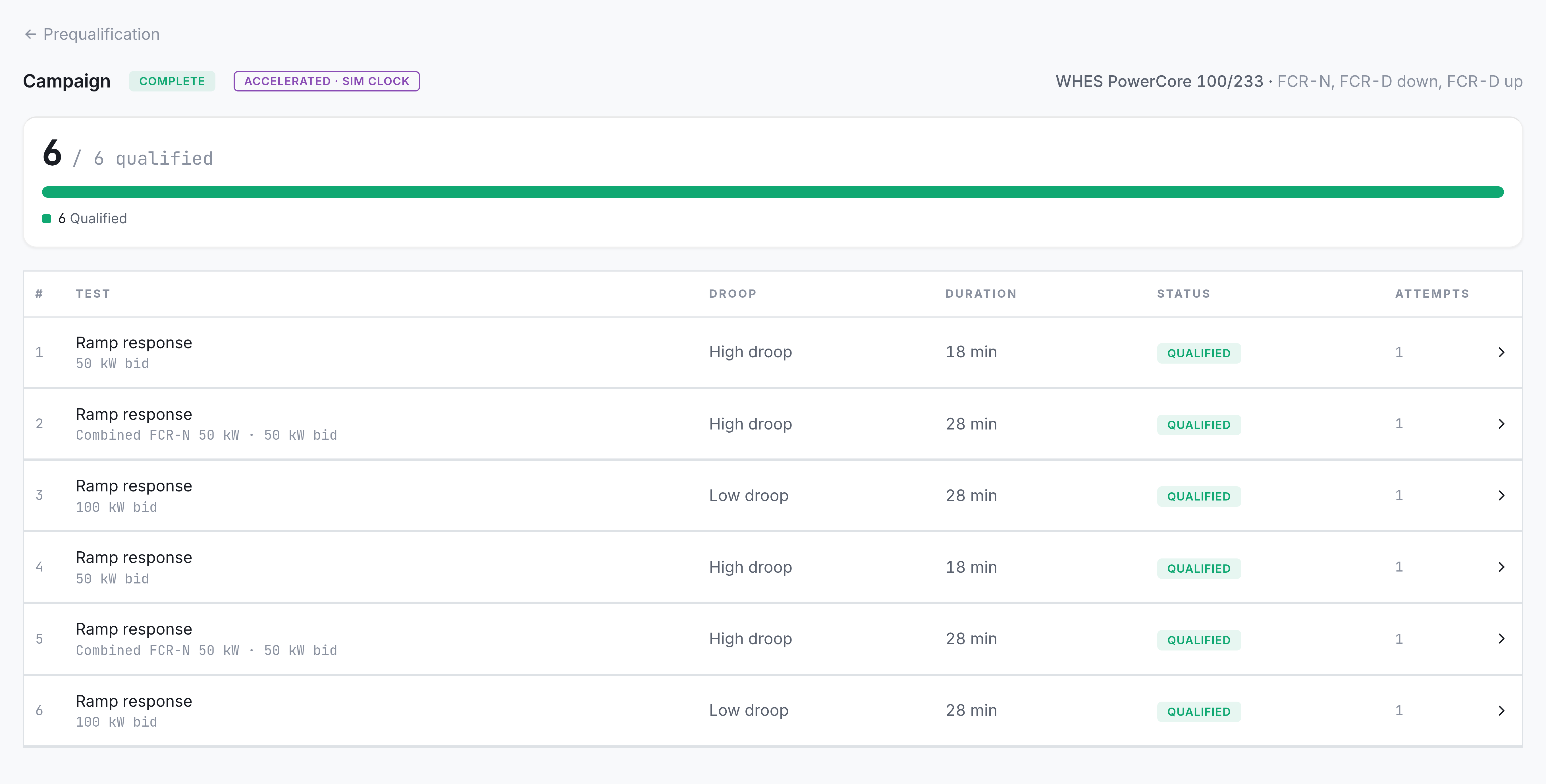
Spot and ancillary market data, automated prequalification campaigns with TSO-format evidence, and the optimizer API with leases and settlement.
Dashboards and workflows with AI builders, chat agents, daily briefings, document vault with extraction, notifications and signed webhooks.
Screens captured from the Evora platform running against simulated battery assets.
Functionality sheet
EVORA LABSSystem overview
Vendor-neutral control layer for battery storage, PV, meters and load banks over Modbus, with a cloud platform for operations and market access.
Local control loop
2 s control tick on the edge; active services are summed, curtailed by priority, then clamped. Runs autonomously through cloud outages.
Safety envelope
Operator-owned kW and SoC limits clamp every setpoint from any schedule or command; out-of-bounds values are clipped, flagged and reported, never applied raw.
Fail-safe behaviour
Stale schedule falls back to a safe default; emergency stop; device heartbeat watchdog re-armed by the edge so power stops on comms loss.
Offline resilience
Store-and-forward buffer for telemetry and events, 72 h / 200 MB, drop-oldest; zero-loss backfill verified in link-cut drills.
Configuration
Cloud-pulled site configuration with last-known-good cache; edits staged and applied on restart.
Services
FCR-N, FCR-D up/down, FFR, aFRR, mFRR up/down, peak shaving.
Prequalification
Automated test campaigns, validators, TSO-format evidence CSVs and application-form values for FCR-N, FCR-D, FFR, aFRR and mFRR across SE1–4, FI, NO1–5, DK1–2 and RO.
Market data
Spot and ancillary prices, procured volumes, grid frequency and tariffs for SE1–4, FI, NO1–5, DK1–2 and RO; public explorers without login.
Optimizer API
Schedule submission with versions and idempotency, exclusive leases with scope and power caps, acknowledgement tracking, per-interval settlement, deviation webhooks, public OpenAPI reference.
Register access for lease holders
Read any register, write those named in the lease, every write read back and audited.
Fleet & sites
Fleet map with health status and zone price tint, site and asset pages, guest invites with roles.
Dashboards & workflows
Drag-and-drop dashboards and a workflow builder, each with an AI builder that proposes changes for review before they apply.
AI operations
Chat agents including an operations agent with tool access, and a daily morning briefing per tenant.
Notifications
In-app feed, email, and signed webhooks for events, deviations and lease changes.
Access control
Tenant isolation, role-based access, scoped API keys, rate limits.
Register explorer
Live view of the device register surface with gated writes, immediate read-back and an audit trail.
Device health
State of health, cell voltage and temperature extremes, rack SoC spread and energy counters polled from the device map.
Warranty envelope
Cycles per day, C-rate and operating days monitored against the warranty terms of the installed product.
Site Brain
Vendor document library with page search and tighten-only limit proposals into the edge configuration.
Document vault
Typed uploads, AI extraction with human review, warranty checks inside workflows.
Remediation
Catalogue of approved healing actions with a durable ledger and operator approval.
Updates
Over-the-air updates on a read-only dual-partition OS with automatic rollback; remote terminal for diagnostics.
Alerts
Faults and alarms decoded from the device map, staleness, curtailment and emergency stop, debounced into raised/cleared pairs.
Site link
Outbound-only MQTT over mutual TLS 1.2 with a per-device X.509 identity and policy. No inbound ports, no VPN.
Hardware root of trust
TPM 2.0, secure boot and a hardware watchdog on the gateway; read-only OS with signed updates.
Hosting
Hosted on AWS in the Stockholm region (EU); GDPR compliant.
Protocols
Modbus TCP, Modbus RTU (RS485), MQTT 3.1.1 over TLS, HTTPS REST/JSON; vendor cloud APIs for EV chargers, heat pumps and PV.
Certifications & standards
ISO 27001 and NIS2 alignment; IEC 60870-5-104 and SunSpec on the protocol roadmap.
Hardware datasheet
EVORA LABSEG-1 (standard) · EG-1C (critical)
A DIN-rail module set for the customer's BESS or site control cabinet: an industrial ARM64 edge computer running the Evora edge agent, a dual-SIM LTE router with the site switch built in, a DC-UPS for ride-through and clean shutdown, and a 24 V supply. The two models differ only in the UPS energy store.
| Bill of materials | ||
| Component | EG-1 | EG-1C |
|---|---|---|
| Edge computer | Compulab IOT-DIN-IMX8PLUS · i.MX8M Plus Quad · 8 GB · 64 GB eMMC · industrial grade | same |
| Router | Teltonika RUT956 · LTE Cat 4 · dual SIM · 4× Ethernet | same |
| DC-UPS | Bicker UPSI-2406DP2 · supercapacitor · 24 V / 4 A | Bicker UPSI-2406DP3 · LiFePO4 · 24 V / 6 A |
| Power supply | 24 V DC / 120 W DIN-rail PSU | same |
| Antenna | External MIMO LTE antenna, 3 m cable, magnetic or bracket mount | same |
| Connectivity | Roaming multi-network IoT SIM, Evora-managed; customer SIM accepted | dual roaming SIM |
Specifications below are component vendor data. Package-level power draw, ride-through and rail length will be measured on the bench rig and updated in Rev 1.0.
| Compute | |
| Processor | NXP i.MX8M Plus Quad · 4× Arm Cortex-A53 1.8 GHz + Cortex-M7 800 MHz · NPU 2.3 TOPS |
|---|---|
| Memory / storage | 8 GB LPDDR4 / 64 GB eMMC, soldered |
| Security | TPM 2.0 · secure boot · hardware watchdog · battery-backed RTC |
| Software | Evora edge agent in a container on a managed read-only OS with A/B updates and automatic rollback |
| Interfaces | |
| Ethernet | 2× 1 GbE (gateway) + 4× 10/100 (router: 1 WAN, 3 LAN) |
|---|---|
| Serial | 2× RS485 (1 isolated) · 2× RS232 (1 isolated) · 1× CAN (isolated) |
| Digital I/O | 4 DI / 4 DO |
| USB | 1× USB 3.0 |
| Cellular | LTE Cat 4, 150/50 Mbps, 3G/2G fallback, dual SIM auto-failover, GNSS |
| Wi-Fi | 802.11, maintenance access only, disabled by default |
| Communication | |
| Device protocols | Modbus TCP · Modbus RTU |
|---|---|
| Cloud link | MQTT 3.1.1 over mutual TLS 1.2, outbound only · HTTPS |
| Measurement inputs | Grid frequency and site power from the PCS or a Modbus power meter; meter not included |
| Device library | 30+ register maps: battery systems, PCS, BMS, PV inverters, plant controllers, meters, load banks |
| Power | |
| AC input | 100–240 V AC, 50/60 Hz via kit PSU |
|---|---|
| DC input | 24 V DC direct (22.5–30 V) as an alternative |
| Consumption | ≤ 15 W typical maximum (gateway ≤ 8 W, router ≤ 7 W) |
| Ride-through | EG-1: ≈ 3–5 min at 10–20 W · EG-1C: ≈ 2 h at 15 W (33 Wh) |
| Environment | |
| Operating temperature | EG-1: −20 … +65 °C · EG-1C: −20 … +50 °C (full output 0 … +40 °C) |
|---|---|
| Storage temperature | −30 … +55 °C |
| Humidity | ≤ 95 %, non-condensing |
| Altitude | ≤ 4000 m |
| Ingress protection | IP20, for installation in an enclosure |
| Cooling | Passive, fanless |
| Mechanical | |
| Mounting | DIN rail EN 50022, ≈ 350 mm rail length |
|---|---|
| Module dimensions (W×H×D) | Gateway 110×30×95 mm · router 110×50×100 mm · UPS 63×120×100 mm · PSU ≈ 40×125×114 mm |
| Weight | ≈ 1.8 kg module set, excluding antenna |
| Compliance & commercial | |
| Certifications | Components: CE, FCC, UKCA, RCM · EN 55032/55035 · EN 61000-6-2/-3 · EN/IEC/UL 62368-1. Kit-level assessment on the roadmap |
|---|---|
| Reliability | Gateway MTTF > 200,000 h |
| Warranty | Kit 2 years; gateway component 5 years |
| Support | Remote diagnostics, OTA updates and email support included; SLA-backed response times optional |
| Licensing | Evora EMS per site per year; contact for pricing |
| Software-only deployments | Any 64-bit Arm or x86 Linux host with Docker, ≥ 4 GB RAM, ≥ 32 GB storage |